Shop around early for new energy contracts is our advice to customers seeking to avoid the risk of skyrocketing energy prices this winter.
Our warning comes hot on the heels of Transpower cautioning that the Electricity Authority’s recommended measures to ensure the security of electricity supply for this coming winter are insufficient, and that urgent action is now needed to prepare for winter demand.
The Gas Industry Company is also ringing the alarm bells saying, “To avoid the situation where some customers are coming to market at times of tightness across the energy sector, we advise industrial and commercial gas customers with upcoming contract renewal to ‘go to market’ for supply well in advance of the contract expiring. It is our view that going to market early will reduce the exposure risk associated with low hydro inflows impacting on gas supply in Q2, 2023.”
Decreasing generation, rising prices
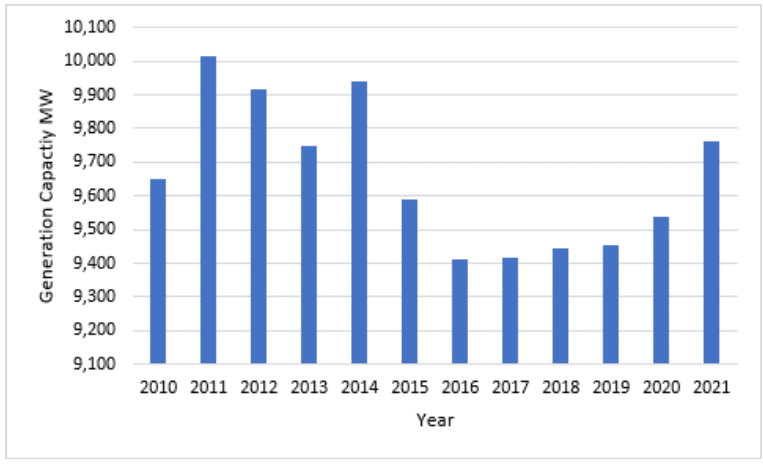
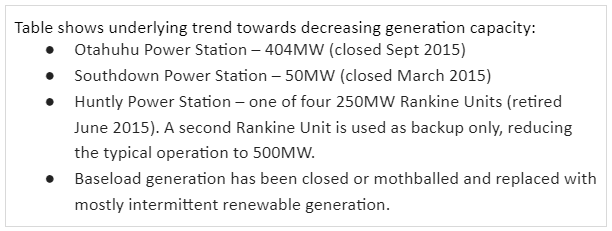
So how and why has this situation arisen? Well, it’s been a long time in the making with NZ’s operational generation capacity reducing since 2010, as thermal base load generators have closed and not been replaced.
New generation that has come on stream since 2010 is mostly intermittent wind generation that is reliant upon the caprice of mother nature. Consider the fact that on an annual basis, NZ wind farms generate at an average of 40% capacity – meaning replacing baseload thermal capacity with like for like wind capacity results in an average 60% shortfall.
The early bird catches the worm…
With all indications pointing towards winter shortage and increasing price volatility, we encourage our clients to review the market well in advance of energy contracts expiring. This allows time to shop around and find the very best deals for your business while you still have some room to manoeuvre.
Leaving it to the last minute will likely leave your business exposed to the vagaries of the winter market and the possibility of surging prices. You could be forced to accept increasingly unfavourable energy contracts that end up costing your business dearly.
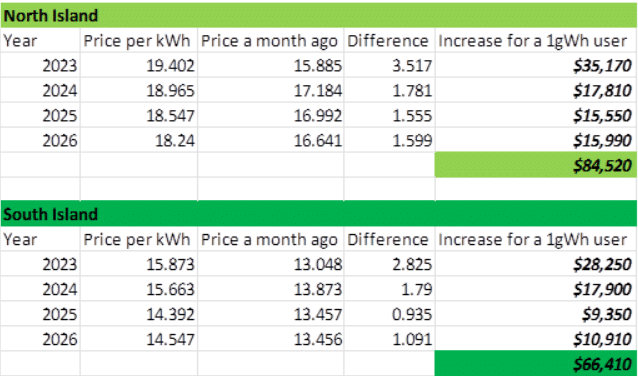
The below tables show how prices have surged over just the last month:
Light at the end of the tunnel?
While the current picture of the energy market seems fairly bleak, there is perhaps some room for optimism with signs pointing to new generation in the pipeline – albeit slowly.
News from Transpower is that NZ could bring on more than 7230 megawatts of new grid-connected generation capacity if the top 51 projects in its new Connections Management Framework are commissioned. Six projects totalling 595MW are currently in delivery phase with 22 projects under investigation.
A Transpower spokesperson says that the new framework, which went live in November, was developed in response to the sharp increase in grid connection enquiries during the 2021/22 financial year. They say enquiries to connect new generation projects to the grid have increased from around five per year, to 124 in FY22.
The new framework has been encouragingly described by Helios Managing Director Jeff Schlichting as ‘robust’ and he believes it should work well to ensure the timely development of renewable energy projects needed to help the country decarbonise and meet its climate change commitments.
Here’s hoping that Jeff’s got it right and that things are finally starting to move in the right direction. In the meantime it pays to prepare early and hunker down for the winter of energy discontent.
Sign up below for Total Utilities Market Commentary to receive all the latest market news and insights.
With prevailing energy market conditions causing sharp price hikes that show no signs of abating – what can you do and who do you turn to for advice and viable solutions?
Since the beginning of 2021, negotiated contract pricing for large commercial customers has increased from 11c/kWh to 18c/kWh for a three year period. This means a customer using one million kWh per year is paying $70,000 more for electricity per year than 19 months ago.
Mass market customers have not been impacted to the same degree with pricing moving from 9c/kWh to 12.5c/kWh.
Rather than bore you with the (too numerous) details and interrelated factors that have caused this unwelcome turn of events, let’s explore the options open to businesses to mitigate sky high energy costs.
Time to turn to the experts? Many businesses are turning to energy management consultancies to help them navigate the challenging energy markets and provide services to assist them to get the very best deal on their utilities.
They are also hiring consultants to explore sustainable and renewable energy options to help them diversify their energy portfolio and give them maximum bang for their buck in terms of energy efficiency, pricing and carbon liabilities.
But according to Total Utilities Director Chris Hargreaves, it’s a case of ‘buyer beware,’ when it comes to hiring an energy management consultancy. He says the quality of service and outcomes vary dramatically.
“If it was my business, there are only a small handful of organisations I would consider using in New Zealand to obtain energy contracts on my behalf and to have the ability and insight required to properly explore efficiency and sustainable solutions.
“The consultancy industry for energy is not regulated, so effectively anyone can start up a business that offers procurement services,” he says.
Chris advises considering various factors before hiring a consultant, including how many procurements they conduct each year. The energy market is highly dynamic and energy retailers are entering and leaving the market at unprecedented rates and pricing models and practices are changing daily.
If the consultant or advisor you are using is not pricing in the market on a regular basis, then you are likely to get caught out by the market changes. Look for companies conducting over 100 procurement exercises per year (as an example, we average almost 350).
You should also establish whether your consultant reviews the entire market of energy retailers for pricing (we do), or just their favoured few companies (nope, not us).
Also, does your advisor or consultant gather detailed market intelligence to track wholesale pricing and industry developments? Do they warn you of potential ‘gotcha’ clauses to look out for in energy contracts as part of their procurement process? Needless to say, Total Utilities ticks all these boxes.
Aside from engaging a reputable energy management consultancy to help you traverse choppy utility waters, Chris explains there are various ways to hedge against rising costs, to minimise budgetary risk and ensure you comply with regulatory requirements.
Cost saving starts with sustainability & efficiency He says that first and foremost, now is the time to explore efficiency, sustainability, and low carbon solutions to increase resiliency.
“By exploring sustainable solutions such as LEDs, Renewable Energy Certificates, solar and energy conservation methods, you can achieve short term wins and relief from volatile energy prices, whilst also unlocking long term sustainability benefits and future proofing your business.
“Sustainability not only saves money by creating energy efficiencies, it also decreases your reliance on the grid, so you are no longer at the mercy of volatile energy prices,” he adds.
Keeping the lights on One of the trends we’re seeing in the industry is a move away from centralised, utility based generation – to so called ‘distributed generation.’ This is a shift from a single source to many sources to allow for increased resiliency and reduced reliance on the grid.
For example, traditionally if the grid goes down, you have no real option to keep your business going. But if you have solar with battery storage, you might be able to keep the lights on until the grid comes back online.
Additionally, you avoid the full impact of market volatility if your energy sources are distributed – it goes back to the wisdom of the old proverb, ‘don’t put all your eggs in one basket.’
Talk to us A great place to start when it comes to navigating the ever-changing energy markets is to talk to our team at Total Utilities. Our data-driven approach, born out of comprehensive investigations and analysis, allows us to carefully tailor energy services and solutions to your business.
With our proven 20 plus years in the energy business, we negotiate over $400 million worth of energy contracts for our clients every year. We can leverage relationships to get you better prices.
Our detailed pricing analysis and tendering services help save time and money by pinpointing the best possible energy contracts and ensuring the most favourable terms and prices.
We put sustainability, cost saving and energy efficiency at the heart of our clients’ businesses, so that they can be both sustainable and highly profitable.
And in this environment, setting sustainability and carbon reduction targets isn’t just about reducing your environmental impact – it simply makes good business sense.
Contact us to find out more about our energy management consultancy services.
Sign up below for Total Utilities Market Commentary to receive all the latest market news and insights.
Staying ahead in business is often about being the first, being the best or doing something that no-one else has thought about.
But being the best demands an ability to gather accurate, independent and reliable information in an increasingly complex world.
Total Utilities Market Commentary will help provide you with all the insights and tools you need to take immediate steps to get the very best deal on your utility prices, while simultaneously leading the way with sustainability best practice. We collate market research and trends to help you navigate volatile energy markets and make better, more informed decisions.
As an independent voice in the market, we strive to deliver holistic insights and advice so that you are better equipped to deal with the changing environment in which we operate.
‘The purpose of information is not knowledge. It is being able to take the right actions.’
Peter F. Drucker
So says founding father of modern business, Peter F. Drucker. Total Utilities Market Commentary helps ensure you have the right information to support the right actions now. We continuously track utility prices in relation to prevailing market conditions so that armed with this knowledge, you can take immediate action to optimise your energy procurement strategy.
No vested interests
As an independent voice in the market, we have no vested interests other than to strive to deliver comprehensive insights and advice. We have been tracking price trends in the energy market since deregulation began and have a comprehensive understanding of the various drivers in the market. We also keep fully abreast of policy and regulation changes to ensure we pass on all the strategic advantages from our independent analysis
As with all things in life, the right actions are not necessarily the easiest or the most straightforward. But we are passionate about providing you with the knowledge to not only leverage the best deals with your utilities, but also to take action now to assist you with decarbonisation and reducing greenhouse gas emissions.
Cleaner, greener business
Paritutu Rock in New Plymouth, New Zealand
At the COP26 summit in 2021, NZ signed up to an agreement to reduce emissions by 50% at 2030 compared to 2005 levels, meaning decarbonisation is no longer a ‘nice to have’ – but critical to future proofing your business.
Sustainable business is about more than just reducing your impact on the environment. Businesses who can create circular economies – i.e., those who save money by eliminating waste and reinvesting in further savings activities – can achieve deep sustainability and lay the foundations for long-term success.
With expertise and guidance provided by our Market Commentary, you can ensure you are reading the latest information regarding competitive energy pricing and make savings to help fund your decarbonisation journey.
And that is most certainly the right action.
Sign up below for Total Utilities Market Commentary to receive all the latest market news and insights.
As the southernmost commercial deep-water port in New Zealand, South Port NZ worked with Total Utilities to implement Centrica Business Solutions’ Panoramic Power™ technology – avoiding costly upgrade projects and increasing available storage capacity.
80% increase in container storage days compared to previous year
10mins to collect data from 51 revenue meters across site
$600k savings from avoided capital project expenses (USD)
Increasing capacity of available on-site storage
South Port NZ is a deep-water port on a 40-hectare Island located in Bluff, New Zealand, from where it provides a full range of marine services, cargo and container shipping, and on-site warehousing for domestic and international customers.
In 2019, South Port NZ partnered with Total Utilities to better understand the actual power demand of the site, identify opportunities to increase existing storage capacity and deliver customised solutions to meet the needs of customers on the island. An initial supervisory control and data acquisition (SCADA) solution was proposed by a 3rd party vendor to address the needs, which came with a price tag of NZD$800,000.
As a partner of Centrica Business Solutions, Total Utilities supplied and DECOM Electrical installed Panoramic Power wireless, device-level, energy monitoring sensors at the port. After a month of capturing the data and analysing it using Centrica Business Solutions’ complimentary energy management software, PowerRadar, South Port NZ deployed an additional 229 Panoramic Power sensors and over 30 communication bridges across the port with minimal interruption to operations. Within days, the on-site infrastructure team gained real-time, granular visibility into the energy consumption and operation of their critical assets across the site. The easy-to-install energy insights solution now transmits data securely via cellular connectivity – monitoring more assets than the initial proposed SCADA solution, at a fraction of the cost.
“PowerRadar provides real-time data on demand versus capacity which allows us to maximize our electrical PowerRadar provides real-time data on demand versus capacity which allows us to maximise our electrical infrastructure while minimising risk. Being a small team looking after the engineering infrastructure of a 40-hectare island, takes a lot of our time. Having something like this that provides us with real-time, easy data, provides efficiencies saving us a lot of time.”
Jason Paul, Project Engineer, South Port NZ
Prior to installing Panoramic Power, the infrastructure team had been unable to determine the maximum number of refrigeration storage units that could be brought online safely at any given time. As such, only eighty electrical plugs were available at any time – one per refrigeration storage unit – within two substations dedicated to handling refrigeration reefers for port customers. With real-time visibility of the measured load across the electrical substations in PowerRadar, the infrastructure team realised that the electrical capacity for these substations was being underutilised – adding more plugs to these substations doubled the reefer capacity to 160 without any major or costly upgrades.
Streamlining resources for managing assets
One of the hurdles of the day-to-day operations at the port was the amount of time spent in collecting data from submeters to invoice port customers. Typically, it would take one of the port’s personnel three days every six months to capture the readings from all 51 revenue meters around the port, regardless of the weather conditions. Using PowerRadar, it now takes them only 10 minutes to collect the meter information before it is passed to their finance team for invoicing customers.
With the monitoring of the sewer pump stations at the port using PowerRadar, the infrastructure team now receives real-time alerts on the status of the motors operated at those stations. This has enabled the reallocation of limited resources to other critical assets at the port. One of the benefits of such reallocation was the detection of surface water ingress at the pump stations by the infrastructure team, having compared the measured power draw of the pumps to available rain data. It is now possible for the infrastructure team to track the amount of surface water ingress at each station on days with rainfall and implement any corrective measures.
Effective planning for infrastructure projects
When trying to identify which assets at the port should be prioritised for capital upgrade projects, the infrastructure team relied on the energy consumption data in PowerRadar. This enabled the team, particularly in the design phase, to plan future expansions as well as ongoing maintenance of the existing electrical infrastructure at the port.
An energy audit was completed for one of the large electrical substations being monitored at the port. The findings resulted in the approval of a large capital project for implementing changes to the substation, and switch board running the Cold Stores and an expected payback within one year.
To ensure the reliability of the substations to handle loads within the port’s electrical network, especially during periods of storing a large number of refrigerator containers, the infrastructure team uses the real-time energy dashboard within PowerRadar to track the maximum power demand from the combined substations. If the power draw approaches 1 MW, the team can begin to consider bringing backup generators online or other ways of taking some load off the power grid at the port.
By choosing to implement Panoramic Power across the site, South Port NZ reduced their capital expenditure by US$600,000 and achieved an increase of 80% in container storage days compared to the previous year. In addition, South Port NZ is now able to report on their carbon footprint annually, provide automatic reports on monthly energy use to port users and streamline efforts in identifying areas of high energy usage for investigating ways to lower the peak demand at the port.
Total Utilities is New Zealand’s largest issuer of business-to-business energy procurement tenders, providing energy purchasing services to many household names. With around 500 tenders issued to the market every year, getting favourable terms is crucial. But negotiating energy contracts is so much more than getting a great price. It involves an understanding of the many moving parts.
The variables that influence retail energy prices are:
GEOGRAPHICAL
New Zealand’s population is dispersed over a large land area, creating its own set of challenges.
FINANCIAL
Prices are based on the changing supply and demand through the wholesale spot market.
MARKET-DRIVEN
The market is deregulated, and our national energy supply consists of generators/retailers, the national grid operator and 29 local distribution companies. Energy retailers can hedge future energy on the ASX Energy Futures market.
SOURCE OF ENERGY
New Zealand has a diverse generation fleet, including hydro, geothermal, wind, and coal.
REGULATORY
The Emissions Trading Scheme, Net Zero 2050 and shifting government policy influence generator behaviours.
TIMING
Changes to hydro storage and government policy mean windows of opportunity can be very limited in the energy market.
That’s why engaging independent energy consultants who understand the variables, the available options and when to time procurement events is so worthwhile.
Let’s look at different scenarios where our clients saved significant sums because they had Total Utilities on their side.
TIMING MATTERS Leaving a negotiation too late gives retailers an unfair advantage, as customers have limited options to choose from. A large university’s contract was due to expire, and they were concerned about going to market too soon. They usually would wait until two or three months before expiry to begin researching options. However, we encouraged them to procure their contract with eight months to go. In doing so, they avoided a 36% cost increase and saved over $2 million.
WE ARE LEVERAGING COMPETITIVE TENSION: A national food producer was given a renewal offer from their energy supplier and told that this was the most competitive option in the market.At Total Utilities, though, we understand that retailers don’t always put their best foot forward unless you give them a push. After we went through a competitive tender process, we negotiated a new renewal offer of over $500,000 less than the previous offer.
DOWNGRADING YOUR METER CAN MAKE A DRAMATIC DIFFERENCE An Auckland-based packaging customer was facing a 40% cost increase over three years. Their retailer was only giving them pricing based on their current meter configuration. This is typical in New Zealand because, unlike other countries, there isn’t a fully contestable meter supplier market. Despite being a large commercial customer, they could downgrade their meter because of their connection size. Total Utilities helped with the meter downgrade and negotiated new pricing on their behalf. As a result, they reduced their cost increase by 75% over three years and saved $200,000. The customer couldn’t believe that changing their meter would have such an impact on their new contract prices.
WE ARE ACTING QUICKLY TO HELP CLIENTS IN NEED A Christchurch-based supplier and manufacturer of commercial refrigeration equipment had been out of contract for more than two months. Struggling on their own to get offers for energy supply, they were at risk of costly spot pricing. Spot pricing changes every half hour making it a volatile and expensive route. The customer asked us for help after getting a renewal offer from their current supplier. The trouble was the offer represented a whopping 225% increase over the next 12 months.Within just five days, we presented the customer with our recommendations. We laid out several energy supply options with different retailers. The best option was 150% lower over the first 12 months than the one previous. What’s more, the new contract was backdated over two months. This meant they avoided default spot prices. Overall, the best option was 27% more cost-competitive over the term of the agreement.
The right energy procurement is crucial
Total Utilities are so much more than negotiators. We have a deep and long-term understanding of the energy market and the many factors that influence supply, price, and demand.You don’t have to settle for the first offer on the table. By engaging us, we leverage the right timing and competitive tension to get you the most favourable terms, saving you significant sums of money over the duration of your contract.
All businesses need electricity. All people in a modern society like ours need electricity. The trouble lies in finding balance between combatting climate change and generating enough electricity to sustain our population.
We all know and understand the importance of decarbonizing given the ominous challenge posed to us by climate change globally. But, New Zealand is a small, remote country which only accounts for 1/15th of 1% of the world’s population of 7.5 billion.
New Zealand’s electricity and natural gas markets are inextricably inter-linked. Electricity and gas compete as alternative energy sources, but rely on each other for production. Electricity generation is the second biggest user of natural gas after methanol production by Methanex. Gas is the second biggest source of electricity generation after hydroelectricity.
With this intricate dependence on one another, the effective management of our national energy strategy (including electricity and gas etc) is critically important to our continuing economic health and hence to the well-being of all 5 million kiwis.
What impact does prohibiting natural gas exploration have on New Zealand’s energy supply?
The outright prohibition three years ago of all new offshore oil and gas exploration, is having a profoundly negative impact on the natural gas sector and hence on the health of the electricity sector.
No matter how well intentioned this original decision was, it was not thought through properly at the time. The recent apparent softening of the Government’s stance on the role of natural gas as a transition energy source on the road to 100% renewability is, however, to be commended.
Coal-based electricity generation in 2020 was the highest for a decade.
It’s unfortunate that, as a result of these policies, coal-based electricity generation in 2020 was the highest for a decade. This coincided with the lowest gas-based electricity generation for nine years.
Given that coal emits +/- 1.9 times more CO2, on a gigajoule-for-gigajoule basis than natural gas, this is an environmental step backwards. In this regard, coal imports of +/- 1 million tonnes from Indonesia in 2020 are currently on course to triple in 2021 as we understand it.
What other factors impact New Zealand’s energy mix?
The negative impacts of the above prohibition have unfortunately been compounded by various other negative electricity supply and demand factors since then.
These factors have included:
Rebounding electricity demand following the Global Financial Crisis in 2008.
Back-to-back very dry summers in 2019/20 and 2020/21.
The retirement of thermal powers stations like Otahuhu B and Southdown.
The inability of new renewable power stations to meet the combined challenge posed by growing electricity demand and reduced thermal generation.
Gas and geothermal energy supply in New Zealand is struggling
Pohokura has been our biggest natural gas field for some years. During the past two years however, production has fallen sharply for unspecified technical reasons. This decline in gas production has reduced gas supplies available both for gas users and for electricity generation.
The prohibition of all new offshore oil and gas exploration, has also meant that there will be no offshore oil rigs available in NZ waters until 2022, at the earliest, to identify let alone resolve the ongoing production problems at Pohokura.
Other gas supply options have been constrained in the longer term by the non-renewal by the Government of existing offshore field permits for undeveloped fields, once their initial term had expired. Previously, successive Government’s lead by both major parties renewed these permits unless there was a compelling specific reason not to.
Power companies are passing costs on to businesses
Seriously damaged gas industry morale has also resulted in a combination of reduced/delayed/cancelled capex in existing gas fields.
Competition has essentially collapsed at the big end of the gas market.
The profound uncertainty surrounding the shorter term, let alone longer term, future of the natural gas industry has already resulted in Contact Energy vacating the time of use (TOU) part of the gas market as TOU agreements covering supply to larger customers expire. Two other gas retailers have also declined to quote for supply to various existing TOU customers.
We are also well aware of other very large TOU gas users (not our clients) who have to use natural gas and have been forced onto punitive spot market-related gas pricing. Major electricity-users like Whakatane Board Mills have also had a huge question-mark over their future due to huge gas-related electricity price hikes.
There is still some limited competition in the non-TOU part of the market (impacting smaller customers), albeit at much higher prices. To all intents and purposes, competition has essentially collapsed at the big end of the gas market.
What would Total Utilities recommend?
Looking to the future, New Zealand must formulate an integrated supply/demand energy strategy covering the transition period until 100% renewable energy is achieved in practice. Much like the cross-party Superannuation Accord in the 1990’s, we need a similar cross-party accord now in this vitally important area.
As such, the Government should:
Reverse its previous ill-advised decision not to extend existing gas field permits on undeveloped fields.
Greatly extend the scope of the existing EECA GIDI Fund/ETA initiatives.
Extend the separate Genesis Energy decarbonisation funding initiative to include Mercury and Meridian too.
To conclude, the appetite for future investment in the gas infrastructure is key to improving certainty in the market. Not only does it send signals to the sellers of natural gas but also to major users who are often multinational organisations. If it becomes more apparent that investment will be very limited, these organisations could very well leave NZ prematurely, obviously impacting employment, business activity and tax revenue.
Business and media enquiries can be made to Total Utilities.