Since 2008, Total Utilities has been a trusted energy and procurement partner to Hall’s Group, one of New Zealand’s largest cold chain logistics providers. In 2025, this longstanding partnership reached a major milestone when Total Utilities supported Hall’s adoption of Lodestone Energy’s virtual solar model—an innovative renewable electricity solution designed to reduce emissions, stabilise long-term energy costs, and future-proof the company’s nationwide operations.
Client Background
Hall’s Group, owned by the Talley’s Group, operates a significant refrigerated transport and cold storage network across New Zealand. Its footprint includes:
Eight cold storage facilities
Nine logistics depots across both islands
A fleet of more than 640 specialised vehicles
Over 700 employees
With major hubs in Tauranga, Napier, Wellington, Christchurch, and Invercargill, Hall’s plays a critical role in maintaining the country’s food supply chain. Its leadership team has a clear long-term strategy: build a more sustainable, cost-efficient logistics network that aligns with customer expectations for low-carbon supply chains.
The Challenge
Hall’s energy demand is both high and mission critical, driven by continuous refrigeration loads across its facilities and vehicle network. The business sought a solution that could:
Reduce exposure to volatile electricity prices
Support its sustainability and emissions reduction commitments
Provide a robust financial pathway for long-term energy planning
Avoid operational disruption
Given the scale of Hall’s network and its continuous power needs, any solution needed to be reliable, future-oriented, and backed by strong analytical validation.
Total Utilities’ Approach
Total Utilities worked closely with Hall’s executive leadership to design and test a comprehensive financial and strategic business case for adopting Lodestone Energy’s virtual solar model.
Our work included:
1. Long-Term Pricing and Risk Analysis
We modelled long-term electricity cost trajectories and compared renewable supply scenarios against traditional procurement models. This analysis highlighted the pricing stability and hedging benefits of Lodestone’s solar-backed supply.
2. Security and Reliability Assessment
We assessed the operational implications of integrating certified renewable electricity into Hall’s distributed cold chain network, ensuring no compromise to 24/7 refrigeration requirements.
3. Alignment with Sustainability Strategy
We evaluated the emissions reduction benefits in the context of Hall’s wider decarbonisation roadmap and customer-driven expectations for climate-aligned logistics partners.
4. Executive Confidence Building
By presenting evidence-based insights, scenario modelling, and risk mitigation pathways, Total Utilities enabled Hall’s leadership to confidently proceed with a progressive, sector-leading energy purchasing strategy.
The Solution: Lodestone’s Virtual Solar Model
Hall’s entered into a long-term renewable electricity supply agreement with Lodestone Energy, supported by Total Utilities’ commercial and strategic advisory. Lodestone will supply Hall’s through its expanding portfolio of utility-scale solar assets, including:
The newly commissioned Whitianga solar farm
The Clandeboye development under construction
An additional soon-to-be-announced solar site
The agreement enables Hall’s to offset the electricity used across its national operations with fully certified renewable energy, ensuring long-term cost stability and meaningful emissions reduction.
Impact
For Hall’s Group
Stabilised long-term energy costs through price-certain renewable supply
Strengthened reputation as a forward-thinking logistics provider
Future-aligned energy strategy supporting nationwide growth
Chief Executive Gareth McFarlane described the agreement as a natural evolution of Hall’s long-term strategy to build a more sustainable and cost-efficient network—one that “genuinely makes a difference” for both the company and its customers.
For New Zealand’s Renewable Energy Landscape
Hall’s joins a group of major organisations adopting Lodestone’s model, alongside companies such as The Warehouse Group and Ingham’s. This contributes to a pipeline of more than 1,000 GWh of annual solar generation, accelerating access to affordable, low-carbon electricity across the country.
A Strengthened Partnership
For over 15 years, Total Utilities has supported Hall’s with strategic energy procurement and advisory services. This latest project underscores the value of a collaborative, long-term partnership built on trust, shared vision, and a commitment to innovation.
By guiding Hall’s through a rigorous assessment and implementation process, Total Utilities helped the organisation confidently transition to a renewable energy solution that supports both commercial outcomes and New Zealand’s wider low-emissions future.
Inghams Enterprises is one of New Zealand’s leading poultry producers, operating multiple facilities nationwide. With a strong focus on cost efficiency and sustainability, Inghams aimed to reduce energy costs and improve environmental performance of its energy contracts.
Challenge
Inghams faced rising electricity costs and needed to explore long-term procurement options. The challenge was to identify a solution that balanced:
Cost certainty
Sustainability outcomes
Operational feasibility
Options considered included traditional electricity supply, on-site solar, and market-based renewable energy solutions.
Our Approach
Detailed financial modelling and market analysis of current and future electricity pricing
Evaluation of multiple procurement pathways: traditional supply, behind-the-meter solar, and Power Purchase Agreements (PPAs)
Feasibility assessment of a solar farm at the Waitoa site
Facilitation of direct engagement with Lodestone Energy to structure a tailored long-term supply agreement
If 2024 taught us anything, it’s that unpredictability is the new norm. From gas shortages and hydro lake levels nearing rock bottom to record highs and lows in pricing, the year had it all.
One thing is clear: the current market structure isn’t serving commercial and industrial customers well. Short-term issues have impacted long-term pricing, forcing customers to pay a premium for future energy, even when conditions might improve.
In a previous article, I delved deeper into how coal sets the overall price in a largely renewable energy grid. You can read more about it here.
Looking Ahead to 2025
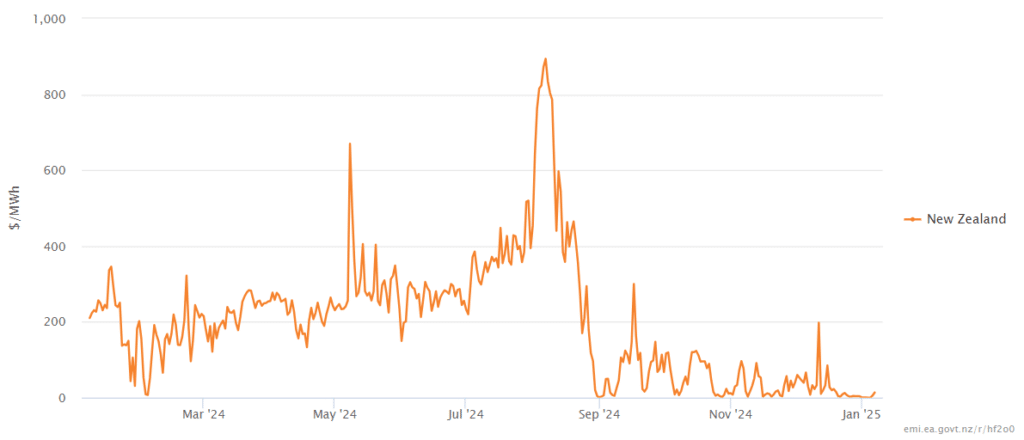
As we step into 2025, hydro storage levels are at 85% capacity, which is 22% higher than usual for this time of year. Wholesale electricity spot pricing remains low, with thermal generation contributing only about 3-5% to the grid. Current prices are around 4-5c/kWh, a significant drop from last January’s 25c/kWh. However, with limited natural gas availability and coal firming the market, price volatility is more pronounced, especially during dry periods when wind generation drops.
Average Daily Wholesale Spot Pricing
The ASX Energy Futures Market
Forward market pricing remains stubbornly high on the ASX Energy Futures market, which sets the overall forward price for retail contracts for large commercial and industrial customers. The current quarter (Jan-Mar 2025) is priced around 12c/kWh in the North Island and 7.4c/kWh in the South Island.
The ASX Energy Futures market is dominated by the big four generators: Contact, Genesis, Mercury, and Meridian. These generators offer volume into the market for participants, which can include other generators, retailers, major energy users, or investment houses.
Long-Term Pricing Trends
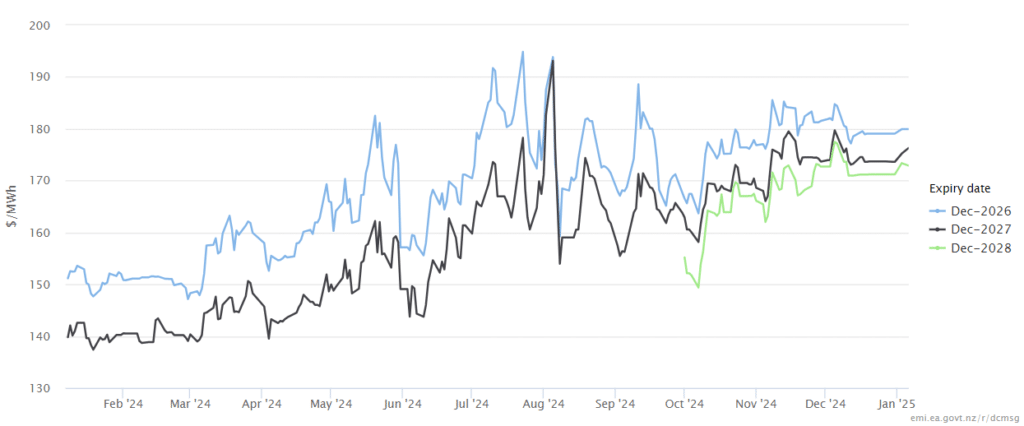
Over the past year, long-term pricing on the ASX has steadily increased as natural gas supplies dwindle. The market seems to be factoring in more risk as coal becomes the dominant fuel for managing limited hydro storage.
North Island pricing for 2026, 2027, and 2028 has risen by 19%, 26%, and 11% respectively since January last year. Similarly, South Island prices have increased by 28%, 35%, and 14%. Notably, pricing for 2028 only became available on the market from October 1st last year. The forward price curve has also shifted from a staggered reducing price to an almost flat price within any given year.
North Island Pricing ASX Energy Futures
The Future of Firming Fuels
This trend suggests that coal will remain the firming fuel of choice for the foreseeable future, despite calls for liquid natural gas imports as a lower carbon emission option. The industry appears divided on future firming solutions, adding to the uncertainty.
As we navigate through 2025, staying informed and adaptable will be key to managing the ever-changing energy landscape.
Navigating the Future of Renewable Energy and Market Volatility
The announcement of new renewable generation projects is exciting, but it comes with its own set of challenges. Much of the new capacity is in solar and wind, both of which are intermittent and cannot be relied upon for firming. While battery storage is becoming more economically viable, it hasn’t reached the point where it can fully replace traditional firming methods. New hydro or geothermal developments, which could provide the necessary baseload generation to support intermittent sources, are facing lower priority due to high costs and resource consent issues.
What to Expect in the Coming Year
As we look ahead, the energy market is expected to remain volatile. Both Transpower and the Gas Industry Company have warned that natural gas production may fall below demand during the upcoming winter. This shortfall will likely keep energy prices unstable. Additionally, the commissioning of new generation projects is progressing slowly, meaning the reliance on fossil fuels for firming will continue in the short term.
Preparing for Contract Expiry in 2025
If your electricity contract is set to expire in 2025, it’s crucial to start planning early. Seeking market pricing well in advance of your contract’s expiry date allows you to set realistic budgets and mitigate the impact of short-term volatility.
Consider exploring solar options, whether on-site or off-site. Both approaches enable you to purchase solar energy as a commodity, reducing your exposure to price fluctuations in the broader energy market.
How Total Utilities Can Help
Total Utilities is here to assist you in navigating these complexities. We offer advisory services to help you evaluate your options and make informed decisions about your energy contracts and renewable energy investments. For more detailed advice, you can read our article on managing utility contract expirations here.
By staying proactive and informed, you can better manage the uncertainties of the energy market and make strategic decisions for your business’s future.